Macbeth
Macbeth is a thrilling exploration of unchecked ambition, tyranny, and the supernatural. It's highly rewarding to study because Shakespeare's brilliant use of language and imagery provides endless opportunities for perceptive, high-level analysis that examiners love.
Study Notes
Overview
Shakespeare's Macbeth (c. 1606) is a dark, intense tragedy that explores the psychological and political consequences of regicide. For GCSE Literature candidates, it offers rich opportunities to analyse complex character development, striking imagery (blood, sleep, darkness), and the tension between appearance and reality. Examiners are looking for candidates who can move beyond plot summary to explore how Shakespeare shapes meaning. Top-grade responses will seamlessly integrate Jacobean contextual factors—such as the Divine Right of Kings and contemporary beliefs in witchcraft—showing how they inform the play's themes rather than just bolting them on as historical facts.
Podcast Episode
Listen to our 10-minute deep dive into the play, covering plot, themes, exam technique, and a quick-fire recall quiz:
Plot/Content Overview
Act 1: The play opens with the witches planning to meet Macbeth. Macbeth, a valiant Scottish general, receives a prophecy that he will be King. Spurred by this and his ambitious wife, Lady Macbeth, he contemplates murdering King Duncan.
Act 2: Macbeth murders Duncan in his sleep. The act shatters his conscience, but Lady Macbeth takes charge, framing the guards. Duncan's sons flee, and Macbeth is crowned King.
Act 3: Paranoia sets in. Macbeth orders the murder of his friend Banquo, whose descendants were prophesied to be kings. Banquo's ghost haunts Macbeth at a banquet, revealing his psychological unraveling.
Act 4: Macbeth seeks out the witches, who offer deceptive apparitions. Believing himself invincible, he becomes a ruthless tyrant, ordering the slaughter of Macduff's family.
Act 5: Lady Macbeth descends into madness, obsessively washing imaginary blood from her hands, and dies. The English army, led by Malcolm and Macduff, attacks. The witches' prophecies unravel (Birnam Wood 'moves', and Macduff is revealed to be born by Caesarean). Macduff kills Macbeth, and order is restored with Malcolm as King.
Themes
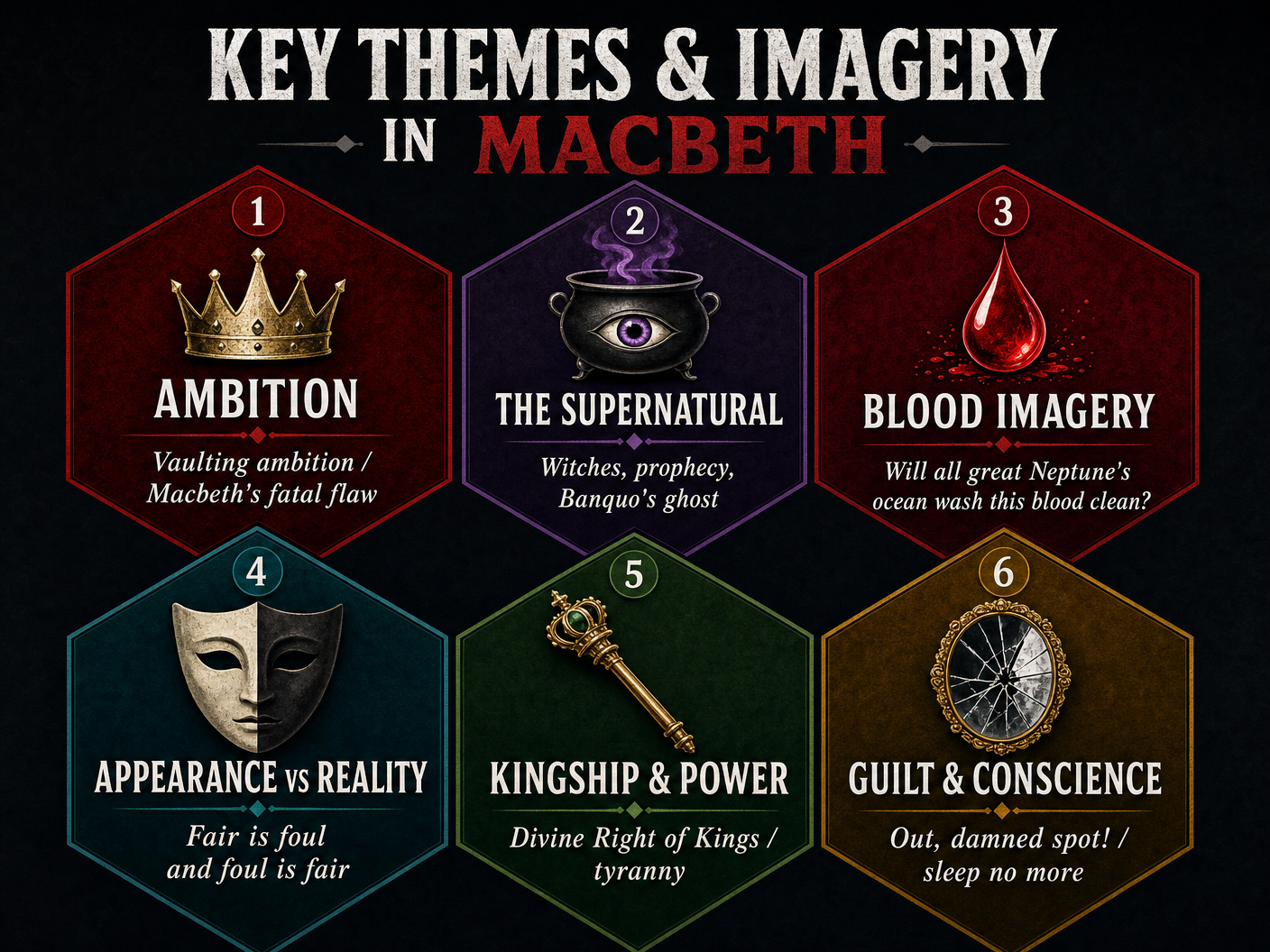
Theme 1: Ambition
Ambition is the driving force of the tragedy. Shakespeare presents it not as an inherently evil trait, but as a fatal flaw when unchecked by moral constraints. Macbeth's ambition corrupts him, transforming him from a "valiant cousin" into an "abhorred tyrant."
Key Quotes:
- "I have no spur / To prick the sides of my intent, but only / Vaulting ambition, which o'erleaps itself" (Act 1, Scene 7) - [Macbeth recognises his ambition is dangerous and unnatural, yet he cannot stop it. The horse metaphor highlights his lack of control.]
- "Art not without ambition, but without / The illness should attend it" (Act 1, Scene 5) - [Lady Macbeth fears her husband is too moral to seize power ruthlessly.]
Theme 2: The Supernatural
The supernatural pervades the play, blurring the lines between reality and imagination. The witches act as catalysts, exploiting Macbeth's hidden desires. Their presence reflects Jacobean anxieties about witchcraft (King James I's Daemonologie).
Key Quotes:
- "Fair is foul, and foul is fair" (Act 1, Scene 1) - [This paradox establishes the play's atmosphere of moral inversion and deception.]
- "Is this a dagger which I see before me" (Act 2, Scene 1) - [The hallucination manifests Macbeth's guilt and the supernatural disruption of his mind.]
Theme 3: Guilt and Conscience
Shakespeare explores the inescapable nature of guilt, primarily through the motifs of blood and sleep. Regicide destroys the perpetrators' minds.
Key Quotes:
- "Will all great Neptune's ocean wash this blood / Clean from my hand?" (Act 2, Scene 2) - [Hyperbole demonstrating the magnitude of Macbeth's guilt; it is a permanent stain.]
- "Out, damned spot! out, I say!" (Act 5, Scene 1) - [Lady Macbeth's prose and fragmented syntax reveal her complete psychological breakdown.]
Character Analysis
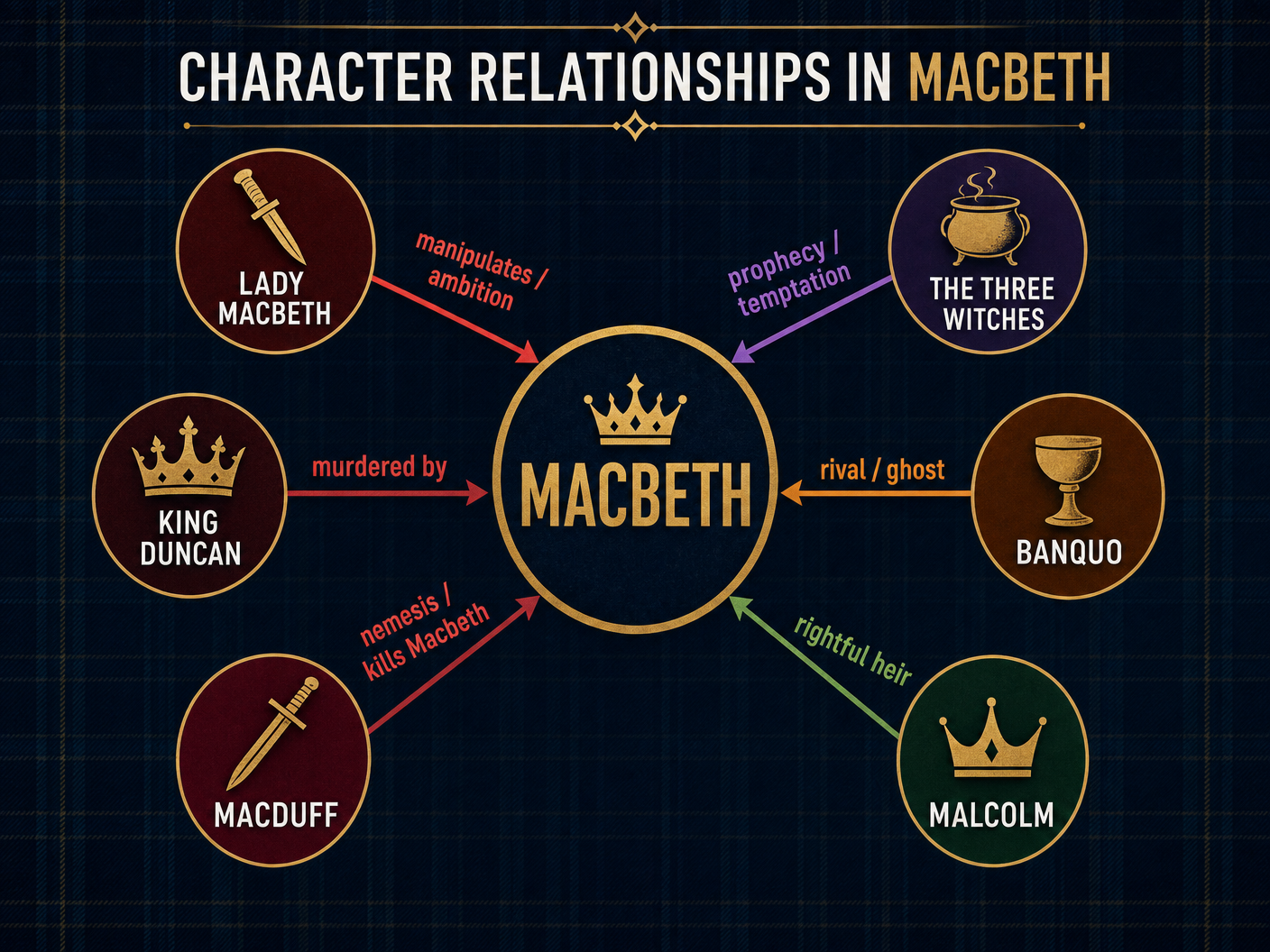
Macbeth
Role: The tragic hero whose fatal flaw (ambition) leads to his downfall.
Key Traits: Brave, ambitious, easily manipulated, increasingly paranoid, ruthless.
Character Arc:
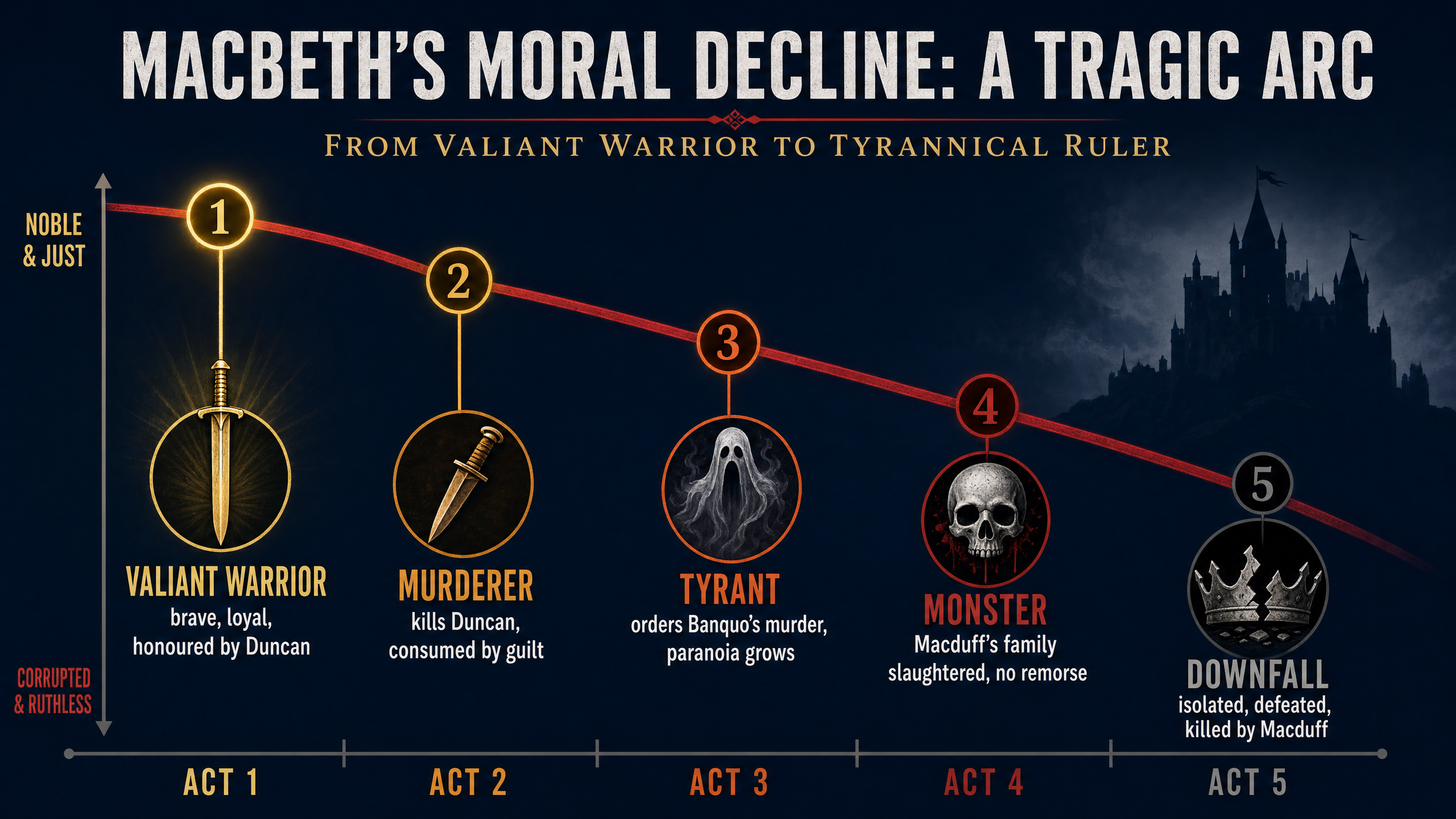
He begins as a loyal, celebrated warrior. The witches' prophecy and his wife's manipulation lead him to commit regicide. He descends into tyranny and paranoia, becoming entirely desensitised to violence before his inevitable death.
Essential Quotes:
- "O valiant cousin! worthy gentleman!" (Act 1, Scene 2)
- "Stars, hide your fires; / Let not light see my black and deep desires" (Act 1, Scene 4)
- "I am in blood / Stepp'd in so far that, should I wade no more, / Returning were as tedious as go o'er." (Act 3, Scene 4)
Lady Macbeth
Role: The catalyst for the murder; challenges traditional gender roles.
Key Traits: Manipulative, ruthlessly ambitious, superficially strong but ultimately fragile.
Character Arc: Initially stronger and more resolute than Macbeth, she drives the plot forward. However, the guilt eventually destroys her mind, leading to sleepwalking and suicide, while her husband becomes emotionally numb.
Essential Quotes:
- "Come, you spirits / That tend on mortal thoughts, unsex me here" (Act 1, Scene 5)
- "Look like the innocent flower, / But be the serpent under't." (Act 1, Scene 5)
- "All the perfumes of Arabia will not sweeten this little hand." (Act 5, Scene 1)
Writer's Methods
Shakespeare uses a variety of methods to shape meaning:
- Dramatic Irony: Used extensively, such as when Duncan praises the Macbeths' castle just before his murder.
- Motifs: Blood (representing guilt and violence), sleep (representing innocence and peace), and clothing (representing assumed titles and roles).
- Verse vs. Prose: Noble characters speak in blank verse (iambic pentameter). The witches speak in trochaic tetrameter (sounding like a spell). Lady Macbeth's descent into madness is marked by a shift from verse to fragmented prose.
- Paradox and Equivocation: The witches use ambiguous language to deceive Macbeth, reflecting the theme of appearance vs. reality.
Context
Examiners expect candidates to integrate context smoothly. Key contextual factors include:
- The Divine Right of Kings: The belief that monarchs were appointed by God. Regicide was a sin against God and nature, which is why nature rebels after Duncan's death (horses eating each other, darkness during the day).
- Witchcraft: King James I was fascinated by and terrified of witches. The inclusion of witches would have been genuinely frightening to a Jacobean audience.
- The Gunpowder Plot (1605): An attempted assassination of King James. The play reflects the contemporary anxiety about treason, equivocation, and the overthrow of the rightful monarch.
Visual Resources
3 diagrams and illustrations
Interactive Diagrams
1 interactive diagram to visualise key concepts
Conceptual Flow Outline
Macbeth's Tragic Arc
Worked Examples
2 detailed examples with solutions and examiner commentary
Practice Questions
Test your understanding — click to reveal model answers
Starting with this extract (Act 3, Scene 4, Banquet Scene 'Avaunt, and quit my sight!'), explore how Shakespeare presents the effects of guilt. (30 marks)
Hint: Focus on Macbeth's loss of control in the extract, then link to Lady Macbeth's sleepwalking in Act 5.
Explore how Shakespeare presents the relationship between Macbeth and Lady Macbeth. (30 marks)
Hint: Look at the power dynamic shift. She dominates in Act 1; he isolates her by Act 3.
Explore the significance of the supernatural in Macbeth. (30 marks)
Hint: Don't just talk about the witches. Include the dagger, the ghost, and the disruption of nature.
How does Shakespeare present Macbeth as a violent character? (30 marks)
Hint: Contrast his 'heroic' violence in Act 1 with his 'tyrannical' violence in Act 4.